Biochar for Building Materials
How Biochar Works in Concrete: Four Parallel Mechanisms
1. Internal Curing: The Most Important MechanismThe honeycomb-like porous structure of biochar particles acts as a network of miniature reservoirs. It absorbs water during mixing and releases it slowly throughout hardening, keeping the cement particles continuously moist. This directly raises the degree of hydration: more cement reacts and more hydration products form, so strength can be maintained or even increased while cement content is reduced.
Strong evidence for internal curing comes from controlled curing experiments. Under dry curing, certain biochar mixtures actually deliver better strength, whereas under continuous moist curing the differences between mixtures narrow. This shows that the internal-curing effect is most pronounced when external curing is limited, because it sustains curing under low-humidity conditions by supplying internal water. For water-scarce regions, or for structural elements that are difficult to cure adequately, the value of this mechanism is far greater than anything it offers under ideal curing conditions.
2. Pore Filling, Densification, and Interface Improvement
Fine biochar particles fill micro-voids in the matrix, densifying the internal structure and blocking connected open channels. At the same time, the rough, porous surface of biochar provides a favorable interfacial transition zone (ITZ) for the cement paste. Scanning electron microscopy (SEM) analysis confirms that the biochar surface promotes the formation of calcium-silicate-hydrate (C-S-H) gel, strengthening the composite. The optimized pore structure typically shows fewer large pores, which in turn reduces water absorption and permeability.
3. Nucleation and Early-Age Hydration Acceleration
The high specific surface area of biochar provides nucleation sites for hydration products, while its internal pore structure tends to shorten setting time and accelerate early-age hydration. This effect contributes positively to early strength, but it also means that at higher dosages, setting time and workability become harder to control.
4. The Workability Penalty
The porous morphology of biochar is also a liability. Unpre-wetted biochar absorbs mixing water, reducing workability and lowering the effective water-to-cement (w/c) ratio. Experiments show that slump generally decreases as biochar content increases. How this problem is handled directly determines practical engineering usability and is a core element of mix design.
The Dosage-Performance Relationship: A Curve That Rises, Then Falls
Multiple studies point to a clear pattern. Within an optimal dosage range (typically 1%-5% by cement mass), biochar improves mechanical performance through matrix densification, hydration promoted by internal curing, and better ITZ bonding. When dosage exceeds roughly 10%, however, the cement matrix is diluted and internal porosity increases; under load, these pores become stress-concentration points that cause compressive strength to decline.The bidirectional relationship between biochar dosage and performance in concrete: low dosages improve mechanical properties and durability, while high dosages turn into a negative contribution.
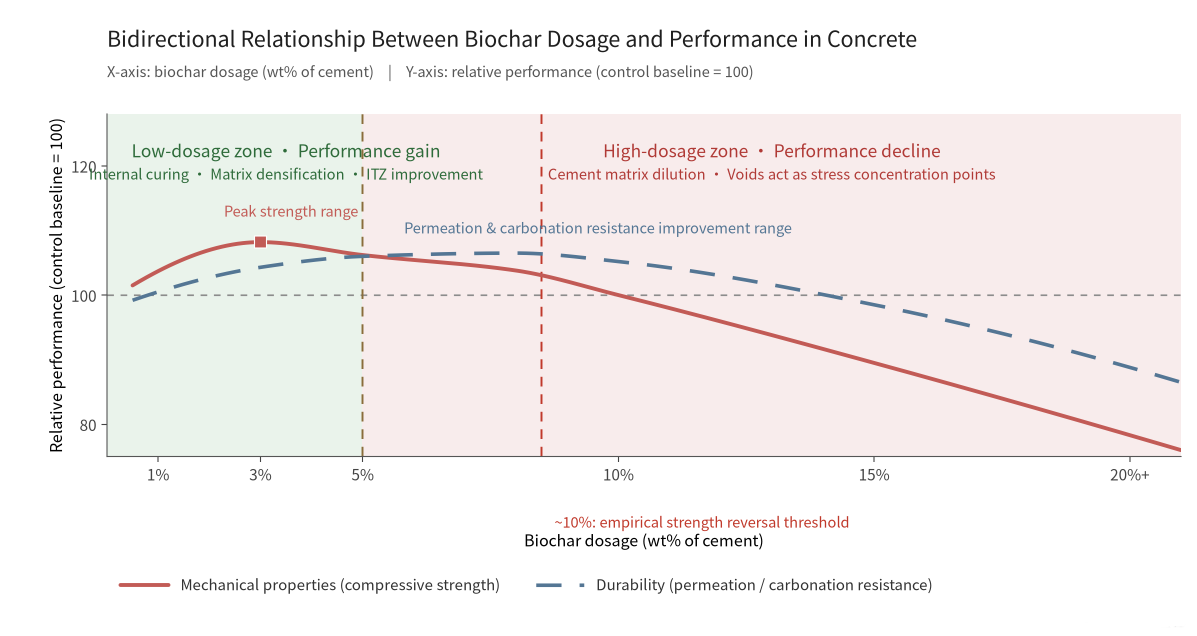
Compiling key figures from published studies, the central thread, “improvement at 1%-5%, decline above 10%”, recurs across different systems.
Two sets of figures in this table are easily misread. The first is “sand replacement, total shrinkage reduced by 41%-65%”: this is a reduction in shrinkage, not in strength, and is a positive benefit. The second is “carbon emissions reduced by 167%”: a figure above 100% means the material as a whole becomes a net carbon sink, but it comes with a 47.4% loss of strength. Overall, high-strength applications should limit biochar to a small fraction of cementitious material mass, whereas high replacement ratios suit scenarios that prioritize carbon storage. The two routes should not be judged by the same criteria.
| Replacement method | Dosage | Performance change | Key source / notes |
| Fine aggregate replacement | 1 wt% | Compressive strength +10% | Heriot-Watt University; the porous structure also improves internal moisture regulation and reduces permeability |
| Cement replacement (fecal-sludge biochar) | 10 wt% | 91-day compressive strength +21%; flexural strength +42% | Scientific Reports; low dosage effectively blocks moisture ingress, with better long-term dimensional stability than conventional mixes |
| Cement replacement | 10 wt% | Carbonation resistance +19.5% | Rashid et al.; attributed to internal curing and a higher degree of hydration |
| Cement replacement | ≤3 wt% | Reduced chloride penetration and carbonation depth | Internal curing promotes hydration and lowers pore connectivity |
| Cement replacement (volumetric w/b method) | 10 vol.% | Compressive strength higher than the 5% mass-based mix | The volumetric method improves workability and internal curing, yielding more hydration products |
| Sand replacement (pre-wetted biochar aggregate) | 30/60/100 vol.% | 28-day total shrinkage reduced by 41%/55%/65% | Drying-shrinkage suppression from improved internal curing is the standout benefit of sand replacement |
| Cement replacement (wood-based biochar) | 5/10/20 vol.% | 56-day compressive strength reduced by 3%/6%/13% | Carbon emissions reduced by 42% (including energy recovery and carbon sequestration) |
| Crushed sand replacement (fruit-based biochar) | 30/60/100 vol.% | 56-day compressive strength reduced by 7%/21%/47.4% | At 100% replacement, carbon emissions fall by 167% and the concrete becomes a net carbon sink |
| Cement replacement | 25 vol.% | At high dosage, biochar particles become defect sources inducing microcracks | X-ray CT shows biochar particles triggering microcracks under load (Lorenzoni et al.) |
| Fine aggregate replacement | 30 vol.% | 28-day compressive strength 13.1 MPa, about 35% below the control | Chen et al.; high replacement ratios generally target maximum carbon storage rather than mechanical performance |
2. Three Critical Control Points in Mix Design
1). Pre-wetting and Volumetric Water-to-Binder Ratio
The water absorption of biochar must be addressed up front. Two common engineering approaches are pre-wetting the biochar (saturating its pores before mixing so it does not absorb mixing water), and replacing conventional mass-based measurement with a volumetric water-to-binder (volumetric w/b) method. The latter has been experimentally verified to improve workability and strengthen internal curing, allowing a 10% volumetric dosage to outperform a 5% mass-based dosage in strength.
2). Particle Size and Feedstock Selection
Particle size affects internal-curing capacity and surface exposure, as well as workability. On feedstock, wood-based biochar typically offers high specific surface area and low ash content, whereas food-waste biochar may contain substantial inorganic residue. These differences directly affect water absorption, particle interactions, and reactivity within the matrix, so biochar selection is far from a secondary consideration in construction applications.
3). Interaction with the Curing Regime
The benefits of biochar are strongly tied to curing conditions. A study on low-clinker cement pastes found that sealed air curing, compared with unsealed conditions, raised compressive strength by 25%-80% across mixtures and reduced water absorption by about 15%, with especially clear effects in ternary systems, because sealing sustains hydration and suppresses concrete carbonation. The study also found that biochar mixtures performed better relative to the 100%-cement reference under air curing than under water curing, precisely because of the internal-curing effect. Mixtures containing fly ash reduced shrinkage by about 22%.
3. Negative Results at Elevated Temperatures
Biochar does not perform well in terms of fire resistance. Studies show it increases the temperature gradient in concrete during heating. Because biochar aggregate replaces a larger volume share and consists of larger individual particles, its impact is greater than that of biochar powder: it aggravates thermal damage and, at 400°C, can even offset the gains from accelerated cement hydration. This means high-replacement biochar-aggregate schemes must be evaluated cautiously for elements that require fire resistance.
4. Alkali-Activated Materials: Mechanisms Different from Conventional Cement Systems
A review published in Cement and Concrete Composites in April 2026 systematically summarizes the role of biochar in alkali-activated materials (AAMs). Its central conclusion is that biochar is not a simple filler: through stable biogenic carbon, a hierarchical pore structure, and surface functional groups, it regulates water migration, gel deposition, pore connectivity, and interface structure.
The review emphasizes that the mechanism in AAMs differs from that in ordinary Portland cement (OPC) systems. OPC relies mainly on clinker hydration and C-S-H formation, whereas AAMs involve a dissolution-polymerization-gel network process of silicon, aluminum, and calcium. Thus, in AAMs, biochar does more than fill and absorb water: it also regulates activator adsorption, ion migration, gel deposition, and pore-structure evolution. The core mechanism governing strength, permeability, and durability is the reconstruction of the pore network.
| Application aspect | Role of biochar | Key conclusion |
| Pore-structure regulation | Refines pores and reduces connectivity | At low dosage, improves internal curing and gas diffusion; excessive dosage forms highly connected transport pathways that increase the entry of aggressive agents |
| Interface structure | Affects the ITZ and crack propagation paths | High dosage causes interface weakening and stiffness mismatch |
| Water migration | Stores water in pores and releases it slowly | Acts as an internal reservoir, slowing internal humidity decline, reducing capillary pressure, and mitigating autogenous shrinkage and cracking |
| CO2 transport | Adsorption, enrichment, diffusion, and carbonate mineralization reactions | Carbon sequestration is achieved jointly through stable biogenic carbon, regulated CO2 transport, and carbonate mineralization |
5. Carbon Sequestration Capacity: From Emission Reduction to Net Carbon Sink
Carbon sequestration in building materials has two sources: the stable carbon carried by the biochar itself, and the emission reductions from energy recovery during pyrolysis, which displaces fossil energy. Together, they can turn concrete from a carbon source into a carbon sink.
| No. | Indicator | Meaning |
| 1 | 42% reduction | Wood-based biochar replacing 20% of cement; reduction in concrete carbon emissions |
| 2 | 167% reduction | Fruit-based biochar replacing 100% of crushed sand; carbon emission reduction (net carbon sink) |
| 3 | Net -14 kg CO2e/m3 | Net GWP (global warming potential) in the Holcim field trial |
| 4 | 1 : 3 | 1 kg of biochar can stably sequester about 3 kg of CO2 |
At the mechanism level of carbon capture, Chinese research offers more detailed findings. Teams from Hefei University of Technology, Zhejiang University, and SIMEC Group pyrolyzed corn stalks into biochar at different temperatures, isolated a “settled particle” fraction, and treated it with an alkaline solution to optimize its micro-pore structure. The results showed that the settled particles had stronger CO2 capture capacity than untreated biochar, and alkali modification enhanced this capacity further; biochar produced at 500°C delivered the best overall performance; and at a 1% replacement level, CO2-saturated modified biochar made the material denser and stronger. The study confirms that biochar captures CO2 mainly through physical adsorption, which is fast and efficient at ambient temperature.
Industrial validation comes from a biochar concrete field trial completed in London by Holcim and the Canary Wharf Group: biochar made from pruned branches and spent coffee grounds was incorporated into concrete, and the optimized mix achieved a net global warming potential of -14 kg CO2e/m3. The solution emphasizes compatibility with existing construction practices: crews need no special training, no redesign is required, and construction schedules are unaffected. Trials by Germany's Fraunhofer UMSICHT indicate an even wider replacement envelope: up to 20% of cement by mass can be replaced by carbonization products, and biochar can account for up to 30% of plastic composites.
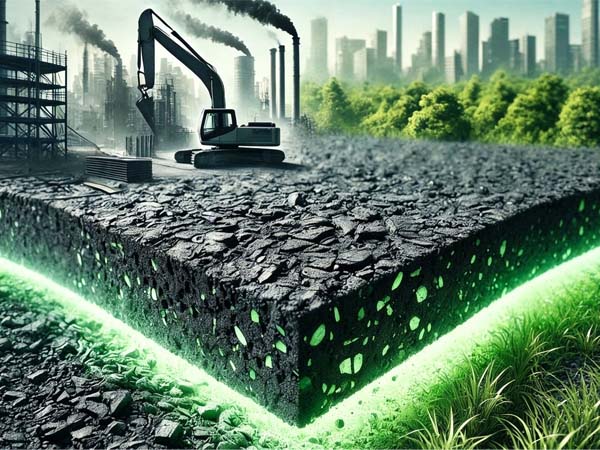
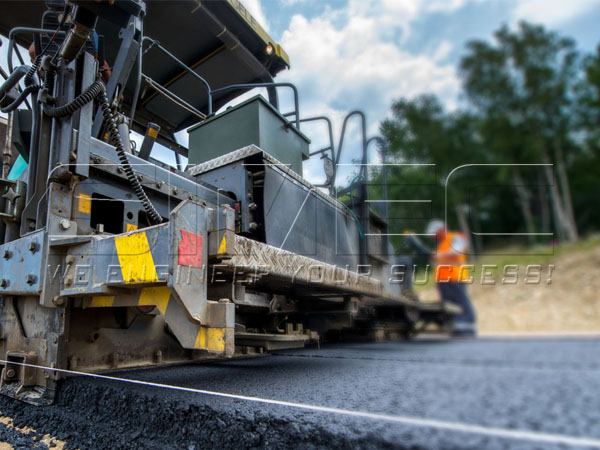
The role of biochar in asphalt has evolved from a substitute for conventional fillers into a multifunctional modifier. Recent reviews note that its applications now extend to rheological modification of asphalt binders, mitigation of asphalt fume emissions, improved aging resistance and interfacial adhesion, and assessment of carbon sink potential.
1. Performance Benefits
Temperature stability: Biochar increases the stiffness and viscosity of asphalt binders, improving high-temperature stability, rutting resistance, aging resistance, and asphalt-aggregate adhesion.
Fume reduction: At appropriate dosages, it cuts emissions of volatile organic compounds (VOCs), polycyclic aromatic hydrocarbons (PAHs), hydrogen sulfide (H2S), and other fumes. This is the most direct compliance benefit for asphalt mixing plants.
Carbon sequestration: Asphalt is a permanent end-use in which carbon is irreversibly locked. Biochar-containing asphalt can generally be fully recycled, and the carbon remains locked throughout recycling.
2. Dosage and Practice
Pilot projects currently use dosages mostly within 3% (by mass). A range of 2%-10% is generally considered technically feasible, but dosage should not exceed 10% of asphalt binder volume. Specific laboratory-optimized values include 12.5% coconut shell biochar as the optimum dosage (a laboratory value above the 10% engineering ceiling noted above; optimized via response surface methodology, it significantly improves stiffness, thermal stability, and durability); 6% coconut shell biochar for a stiffer asphalt; and 10% switchgrass biochar for improved rutting resistance.
The “biochar asphalt concrete” jointly developed by Japan's Shimizu Corporation and Nippon Road provides industrial-scale data. At a 3% addition rate, the CO2 fixed by biochar is about 14 times that of conventional warm-mix modified asphalt Type II, while the unit carbon-reduction cost is only about 10% of conventional technology. Wheel-tracking tests show its flow resistance is comparable to conventional modified Type II asphalt mixtures, and construction requires no special equipment, existing machinery configurations can be used. A Dutch bicycle-path pilot went further, placing the material at ambient temperature with 1% biochar in the surface layer and 5% each in the binder and base courses, powered solely by solar electricity.
3. Applicability and Limitations
The conclusions for asphalt are clearly condition-dependent. Multiple studies show biochar tends to improve high-temperature performance but worsen low-temperature performance, so it is better suited to low-compaction pavements or subtropical and tropical climates. Excessive dosage or poor dispersion reduces low-temperature crack resistance and fatigue life, and may cause phase separation or even increase VOC emissions. The central question in this field has shifted from “whether biochar works” to “under what conditions, for which pavement-performance and pollution-control objectives, and at which life-cycle stage it should be used.” Empirical dosage choices need to give way to the coordinated optimization of structure, performance, emission mitigation, and life-cycle impact.
Other Building Material Forms
Biochar is mixed with molten slag, spread, then mechanically stirred and compacted. This improves soil properties (lowering moisture content and increasing the sand fraction) and raises foundation strength, reducing the amount of cement-based stabilizer and bringing CO2 emissions close to zero. The feedstock, molten slag from general solid waste, and sawdust as a lumber by-product, comes from waste reuse.
Plastics and Composites
As a filler, biochar can reduce product carbon footprints or tailor performance. It can account for up to 30% of plastic composites. Key control parameters are porosity, particle size distribution, adhesion behavior, and pollutant leaching.
Insulation Materials and Products
The low thermal conductivity and porous nature of biochar are used to make insulation materials. It is also used in consumer products such as charcoal bags and charcoal bricks, a category with low technical barriers but stable scale.
Activated Carbon Filter Replacement
Once activated, biochar can serve as an alternative source of activated carbon filter material for water and air purification, a pathway for biochar into higher-value filtration materials.
Standards and Compliance Status