Seven Industrial Tracks for Biochar
This expansion rests on a materials-science fact: biochar offers three functional carriers that can be called on independently. The first is a stable aromatic carbon framework, which determines the duration of carbon storage and the material’s electrical conductivity. The second is a hierarchical pore network, which governs adsorption and internal-curing capacity. The third is an abundance of surface functional groups, which control complexation and catalytic activity. Each of the seven application directions draws on a different core property and therefore calls for a different balance among the three.
This article first lays out the mapping from properties to applications, then surveys each of the seven directions in turn, and ends with a maturity map and a decision framework. The in-depth treatment of each direction is developed in seven dedicated articles, each organized in four layers: mechanism of action → performance data → process and formulation requirements → economics and boundary conditions.
The Technical Foundation: How Properties Set the Boundaries of Application
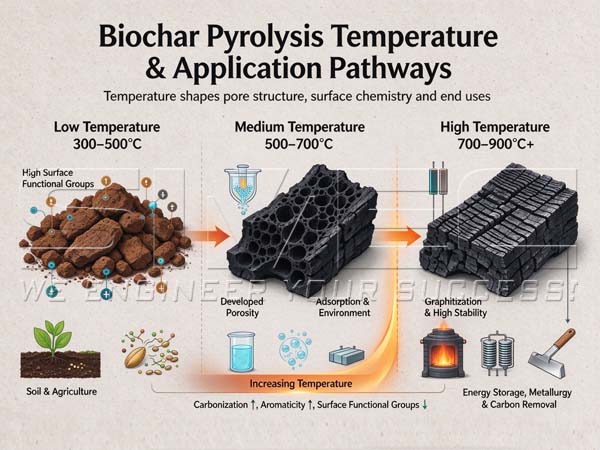

Pyrolysis Temperature: The Fork in the Road
Low-temperature biochar (300–400 °C) retains more dissolved organic carbon and oxygen-containing functional groups, is more readily used by microorganisms, and is better suited to direct chemical interaction with soil minerals. High-temperature biochar (600–700 °C and above) is more highly aromatized, more stable, and more electrically conductive, making it better suited to long-term carbon storage and electron-transfer applications. For agricultural carbon storage, once yield, energy use, and storage effect are weighed together, around 400 °C is generally regarded as the most cost-effective range; when long-term stability is the goal, 600–700 °C is preferable.
| Comparison Dimension |
Low-Temperature Biochar (300–400 °C) |
High-Temperature Biochar (600–700 °C and above) |
| Carbon Framework | Lower degree of aromatization; more readily utilized by microorganisms |
High degree of aromatization; high stability |
| Surface Functional Groups | Rich in oxygen-containing functional groups; high chemical reactivity |
Fewer functional groups; lower chemical reactivity |
| Pore Structure & Conductivity | Weak electrical conductivity |
Good electrical conductivity; high degree of graphitization |
| Typical Destinations | Agricultural soil, biochar-based fertilizers, pollution remediation | Carbon sequestration, hard-carbon anodes, metallurgical reducing agents |
An Important Structural Constraint
A three-dimensional X-ray micro-CT study of biochar made from densified corn-straw pellets across the 1000–1400 °C range reaches a conclusion that matters a great deal for application design: as temperature rises, the carbon structure becomes increasingly ordered, while the pore network becomes increasingly fragmented. The Raman ID1/IG ratio falls from 3.91 to 1.05 (less disorder, greater graphitization). Total porosity measured by micro-CT rises from 21.22% to 35.48%, yet the BET specific surface area falls from 1037.25 m²/g to 605.17 m²/g. The average channel length shortens from 20.8 μm to 11.4 μm, and isolated porosity increases nearly threefold.
The implication for applications is that total porosity is a necessary but not a sufficient condition. Applications that depend on connectivity: adsorptive filtration, internal curing of concrete, and catalyst supports are really constrained by the share of isolated pores and by channel length. Applications that depend on the carbon framework itself: carbon storage, hard-carbon anodes, and metallurgical reducing agents only need the carbon to be stable and ordered enough, and pore fragmentation is no obstacle. The same batch of high-temperature biochar can be a first-rate feedstock for energy storage yet a comparatively poor choice for adsorption. This constraint will recur across all seven tracks.
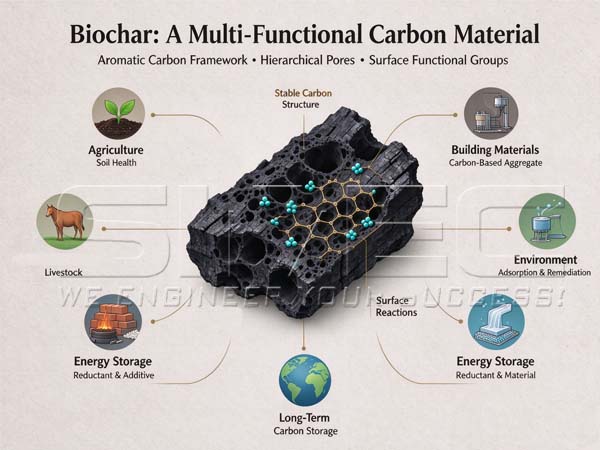
| Track | Typical Uses / Products | Core Properties Drawn On | Key Value Proposition |
| ① Agriculture and Arable Land | Biochar-based fertilizers, soil amendment | Functional groups, pores | Biochar-based fertilizers cut chemical-fertilizer use by 20–30% |
| ② Livestock and Animal Farming | Feed additives, bedding |
Pore adsorption, functional groups |
Beef cattle slaughter weight rises by 15.45 kg per head |
| ③ Building Materials | Concrete, asphalt, plastics |
Connected pores, carbon framework |
Net concrete GWP of −14 kg CO₂e/m³; asphalt carbon-abatement cost is only 10% that of conventional techniques |
| ④ Environmental Remediation | Water treatment, soil remediation |
Connected pores, functional groups |
Adsorbs pollutants and remediates soil and water |
| ⑤ Energy and Energy Storage | Sodium-ion hard carbon, supercapacitors | Carbon-framework ordering, electrical conductivity | Sodium-ion hard-carbon capacity of 369 mAh/g |
| ⑥ Metallurgy and Industry | Coke and injection-coal replacement | Carbon-framework stability | Replaces fossil-based reducing agents and fillers |
| ⑦ Carbon Removal and Carbon Assets | Carbon credits, carbon assets (verified carbon-removal trading) | Long-term stability of the aromatic carbon framework | Carbon credits at around US$164 per tonne |
Track 1 · Agriculture and Arable Land
This is biochar’s oldest application. Once low-temperature biochar is incorporated into soil, its oxygen-containing functional groups and pore network retain water and nutrients, provide habitat for microorganisms, and combine with soil minerals to form a stable organic-carbon pool. Biochar-based fertilizers, which use biochar as a carrier, have cut chemical-fertilizer use by 20–30% across a range of crops and are currently the most mature commercial form. See the dedicated article “Track 1: Biochar for Agriculture and Arable Land.”
Track 2 · Livestock and Animal Farming
Biochar is used as a feed additive. Through pore adsorption and functional-group complexation, it adsorbs intestinal toxins, curbs harmful fermentation, and improves the digestive environment. Trial data show that beef cattle fed biochar finished 15.45 kg heavier per head. See the dedicated article “Track 2: Biochar for Livestock and Animal Farming.”
Track 3 · Building Materials
Biochar is entering three product lines at once: concrete, asphalt, and plastics. In concrete, connected pores perform the water-delivery function of “internal curing,” bringing the net global warming potential of low-carbon concrete to −14 kg CO₂e/m³. In asphalt, the carbon-abatement cost of biochar modification is only 10% that of conventional techniques. The plastic-filler direction is still at an early stage. See the dedicated article “Track 3: Biochar for Building Materials.”
Track 4 · Environmental Remediation
Drawing on connected pores and surface functional groups, biochar is used to adsorb pollutants in wastewater and flue gas and to remediate contaminated soil and water. This is the track whose material logic is the most direct. See the dedicated article “Track 4: Biochar for Environmental Remediation.”
Track 5 · Energy and Energy Storage
Here, the aromatic framework and electrical conductivity of high-temperature biochar become the hard-carbon anode of sodium-ion batteries, with a reversible capacity of up to 369 mAh/g. The supercapacitor direction remains at an early stage. The challenge is to turn biomass from diverse sources, with its fluctuating properties, into electrode material with consistent performance—and machine-learning-driven “smart carbonization” is now addressing this. See the dedicated article “Track 5: Biochar for Energy and Energy Storage.”
Track 6 · Metallurgy and Industry
Biochar enters steelmaking and other processes as a reducing agent, recarburizer, and industrial filler, drawing on the stability and reactivity of the carbon framework itself. See the dedicated article “Track 6: Biochar for Metallurgy and Industry.”
Track 7 · Carbon Removal and Carbon Assets
This is the track that best shows biochar’s natural advantage: the aromatic carbon framework can remain stable in soil or in materials for decades to over a century, and the resulting carbon removal, once verified, becomes a tradable carbon credit, currently priced at around US$164 per tonne. It naturally stacks with tracks such as agriculture and building materials, creating the stacked pricing of “a ton of biochar plus a carbon-removal service.” See the dedicated article “Track 7: Biochar for Carbon Removal and Carbon Assets.”
|
Tier
|
Tracks
|
Characteristics
|
|---|---|---|
|
Tier 1:
Commercially mature, leading in scale |
Agricultural biochar-based fertilizers; carbon removal and carbon assets
|
Value propositions validated by the market; buyers and pricing mechanisms established
|
|
Tier 2:
Value validated, scale-up imminent |
Sodium-ion hard carbon, low-carbon concrete, biochar asphalt, livestock feed, environmental remediation
|
High technological maturity; scale in ramp-up or regional rollout
|
|
Tier 3: Early stage
|
Metallurgical reducing agents, supercapacitors, plastic fillers
|
Technically feasible; cost-advantage link not yet established
|
| Ask First | Then Judge | Points To |
| What is the feedstock? | Wood/nut shells → good stability and pores; straw → rich functional groups but mind the ash; manure → high nutrients but pollutant risks must be controlled | Shells → hard carbon; wood → building materials/long-term carbon storage; straw → biochar-based fertilizers/adsorption |
| Where is the target market? | Are there local offtakers (farmland, mixing plants, wastewater plants, cell factories)? | Determines transport radius and economics; biochar is a low-value, high-volume product |
| Can carbon revenue be secured? | Certification capability (EBC/WBC), methodology choice, and whether an MRV system is in place | Carbon revenue can dilute costs and is the key for agriculture to escape “cost inversion” |
| Need carbon “active” or “stable”? | Active → low-temperature biochar, retaining functional groups; stable → high-temperature biochar, higher aromatization | Determines the pyrolysis-temperature range and the entire process route |
| Is pore connectivity required? | Adsorption/internal curing need connectivity; carbon storage/energy storage only need the carbon framework | Avoid using high-isolated-porosity biochar for adsorption |
| Are customers agricultural or industrial? | Agriculture cares about yield gains and soil effects; industry cares about batch consistency, impurity limits, and delivery stability | Industrial customers require an upgraded quality-control system, often harder than expanding capacity |
Third, the safety-management system needs to keep pace with the speed of expansion. Biochar applications carry certain environmental risks: acidification may mobilize heavy metals in soil, the migration of colloidal particles may cause subsurface spread of pollutants and nutrients, and the release of dissolved organic carbon (DOC) can worsen nutrient loss. The building-materials direction needs to watch pollutant leaching, the feed direction must hold to contaminant limits, and the water-treatment direction must guard against secondary release once adsorption sites are saturated. These problems will not stop the industry from growing, but they will determine how far it can go. As a feed additive, biochar must also be used within the recommended dosage limits for each animal species; the dose must not be increased at will.
Conclusion
Agricultural biochar-based fertilizer wins over farmers with “20–30% less chemical fertilizer”; low-carbon concrete wins over contractors with a “net GWP of −14 kg CO₂e/m³”; sodium-ion hard carbon wins over cell makers with “369 mAh/g”; asphalt wins over project owners with “abatement costs only 10% those of conventional techniques”; carbon removal wins over buyers with “US$164 per tonne”; and livestock wins over farms with “15.45 kg heavier per head at slaughter.” Behind every direction that has genuinely landed is a verifiable, quantifiable value proposition.
For the metallurgical reducing agent, supercapacitors, and plastic fillers, still at an early stage, what is missing is not technical feasibility but the link that converts a technical advantage into a cost advantage. Conversely, the difficulty in broad-acre agriculture is not lack of effect but that costs still outweigh returns.
The biochar industry is standing on the threshold between “able to prove it works” and “able to prove it pays.” Crossing that threshold requires not only better biochar but also a more complete standards system, more accurate carbon-accounting methods, and a smoother feedstock collection and storage network.