Advanced Burner for Exhausted Olive Pomace
Exhausted olive pomace is a promising lignocellulosic biomass fuel. On an air-dried basis, it typically has a moisture content of 8–20%, a lower heating value of 3,000–3,800 kcal/kg, and a volatile matter content of 68–75%. Following drying and pelletization, its effective energy density can be significantly improved, with its lower heating value reaching around 4,200–4,600 kcal/kg, close to the level of conventional agricultural biomass fuels. Given its high cellulose, hemicellulose, and lignin fractions, exhausted olive pomace is well suited for renewable energy generation such as direct combustion, co-firing, etc.
| Proximate analysis | ||
| Element | Typical Value | Unit |
| Residual Oil | 1-3 | % wt |
| Cellulose | 18-25 | % wt |
| Hemicellulose | 15-20 | % wt |
| Lignin | 25-35 | % wt |
| Extractives | 2-5 | % wt |
| Ash | 2-4 | % wt |
| Fixed Carbon | 18-22 | % wt |
| Volatile Matter | 65-72 | % wt |
| Ultimate analysis | ||
| Element | Typical Value | Unit |
| Carbon (C) | 50-54 | % wt |
| Hydrogen (H) | 5.5-6.5 | % wt |
| Oxygen (O) | 36-41 | % wt |
| Nitrogen (N) | 0.8-1.5 | % wt |
| Sulfur(S) | 0.05-0.2 | % wt |
| Chlorine (Cl) | <0.05 | % wt |
However, exhausted olive pomace (EOP) also has significant drawbacks: a high content of alkali metals such as potassium and sodium, which easily leads to coking and slagging in conventional biomass burners.
In addition, the material exhibits high hardness and a complex particle size distribution (25-40% fine particles, 35-50% medium particles, 15-25% coarse particles, including 6-14 mm olive pits), which places high demands on the wear resistance of the grate.
Although conventional biomass burners feature a lower initial investment, they present three critical drawbacks when firing exhausted olive pomace:
1. Low combustion efficiency, unable to meet the growing steam demand. The uneven particle size, high ash content and high hardness of EOP lead to incomplete combustion and poor heat transfer, limiting the achievable steam output.
2. Unstable operation due to manual feeding. Manual feeding cannot guarantee uniform and continuous fuel supply, resulting in significant fluctuations in thermal load and steam pressure. The lack of automated control over fuel feed, combustion air and load regulation further weakens operational stability and system automation level.
3. Severe slagging and coking. The high alkali metal content in EOP readily forms low-melting-point clinkers, which block the grate and impede air distribution. This not only reduces heat exchange efficiency but also requires frequent shutdowns for de-slagging, significantly increasing operation and maintenance costs and safety risks.
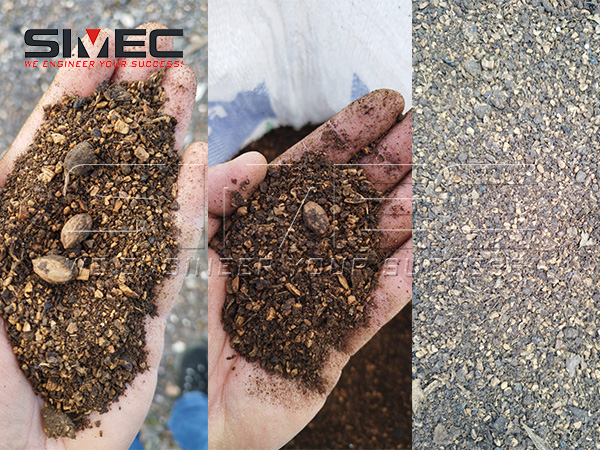
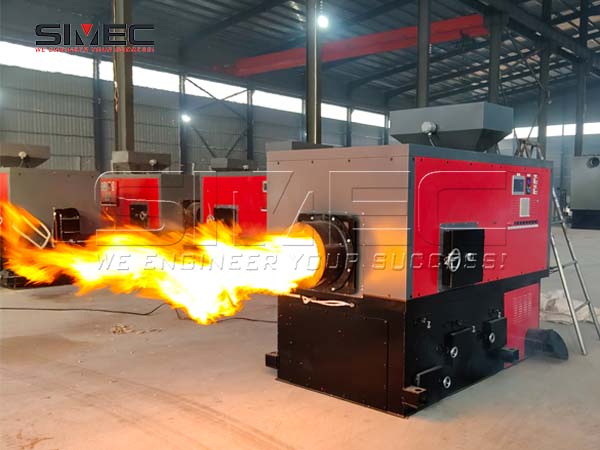
With a dedicated anti-slagging structure and optimized high-temperature combustion zone, the SIMEC biomass burner effectively suppresses clinker formation and coking induced by the high alkali metal content in exhausted olive pomace. Meanwhile, its fully automated feeding, ash discharging and precise temperature control ensure stable fuel input and steady thermal output, eliminating steam pressure fluctuations and unstable combustion.
Highly adaptable to complex biomass fuels, especially olive pomace with high hardness, wide particle size distribution and high ash content, the SIMEC biomass burner improves combustion efficiency and reduces fuel consumption. Its high degree of automation also lowers labor intensity and operation costs.
In contrast to traditional burners that suffer from slagging, instability and low efficiency, SIMEC technology integrates outstanding anti-slagging performance, high automation and superior efficiency, making it the ideal clean and reliable energy solution for industrial users.